
◆#51 The Business of Managing and Marketing in the Age of Diversity (2009)·A 2009 contribution to Philip Kotler's body of marketing thought.·Today's Insight:Strategy is choosing what not to do as much as what to do.◆#52 Marketing Management: A South Asian Perspective (2009)·The seminal 2009 framework for strategic marketing analysis, planning, and control.·Today's Insight:A city's brand is the sum of the stories outsiders tell about it.◆#53 Out of the Poverty Trap: Social Marketing Solutions (2009)·How marketing principles can drive social change and improve public behavior (2009).·Today's Insight:Change starts with understanding what your audience values — not what you want them to do.◆#54 Marketing Management: China Edition (2009)·The seminal 2009 framework for strategic marketing analysis, planning, and control.·Today's Insight:Segmentation, targeting, and positioning — STP — is the strategic core of every marketing plan.◆#55 Social Marketing for Public Health: Global Trends and Success Stories (2009)·How marketing principles can drive social change and improve public behavior (2009).·Today's Insight:Change starts with understanding what your audience values — not what you want them to do.◆#56 Marketing 3.0: From Products to Customers to the Human Spirit (2010)·From products to customers to the human spirit — the 2010 manifesto for values-driven marketing.·Today's Insight:Technology should amplify human judgment, not replace the human at the center of the brand.◆#57 Building Strong Communities (2010)·A 2010 contribution to Philip Kotler's body of marketing thought.·Today's Insight:Strategy is choosing what not to do as much as what to do.◆#58 Ingredient Branding: Making the Invisible Visible (2011)·Building and managing powerful brands in business-to-business markets (2011).·Today's Insight:Strategy is choosing what not to do as much as what to do.◆#59 The Quintessence of Strategic Management (2010)·A 2010 contribution to Philip Kotler's body of marketing thought.·Today's Insight:Strategy is choosing what not to do as much as what to do.◆#60 Social Marketing to Protect the Environment: What Works (2012)·How marketing principles can drive social change and improve public behavior (2012).·Today's Insight:Change starts with understanding what your audience values — not what you want them to do.◆#61 Winning at Innovation: The A-to-F Model (2012)·A practical model for winning at innovation in modern markets (2012).·Today's Insight:Innovation begins by breaking a single assumption inside an existing category.◆#62 Good Works! Marketing and Corporate Initiatives That Build a Better World (2013)·How companies do the most good for their business and their cause (2013).·Today's Insight:Strategy is choosing what not to do as much as what to do.◆#63 A Stakeholder Approach to Corporate Social Responsibility (2012)·How companies do the most good for their business and their cause (2012).·Today's Insight:A cause is most powerful when it sits at the intersection of company strengths and societal need.◆#64 Marketing Your Way to Growth: 8 Ways to Win (2013)·A 2013 contribution to Philip Kotler's body of marketing thought.·Today's Insight:Strategy is choosing what not to do as much as what to do.◆#65 Marketing Management for Higher Education (2014)·The seminal 2014 framework for strategic marketing analysis, planning, and control.·Today's Insight:Segmentation, targeting, and positioning — STP — is the strategic core of every marketing plan.◆#66 Confronting Capitalism: Real Solutions for a Troubled Economic System (2015)·Kotler's perspective on the great challenges facing society (2015).·Today's Insight:The hardest problems are wicked: they resist final solutions and demand continuous adaptation.◆#67 Think New ASEAN: Rethinking Marketing Toward ASEAN Community (2015)·Marketing strategy and management adapted for Asian markets (2015).·Today's Insight:Strategy is choosing what not to do as much as what to do.◆#68 Transformational Sales (2016)·Transformational marketing for a rapidly changing world (2016).·Today's Insight:Strategy is choosing what not to do as much as what to do.◆#69 Democracy in Decline: Rebuilding Its Future (2016)·Kotler's perspective on the great challenges facing society (2016).·Today's Insight:The hardest problems are wicked: they resist final solutions and demand continuous adaptation.◆#70 Marketing 4.0: Moving from Traditional to Digital (2017)·Kotler's 2017 guide to moving marketing from traditional to digital.·Today's Insight:Technology should amplify human judgment, not replace the human at the center of the brand.◆#71 Marketing for Competitiveness: Asia to the World in the Era of Digital Consumers (2017)·Marketing strategy and management adapted for Asian markets (2017).·Today's Insight:A city's brand is the sum of the stories outsiders tell about it.◆#72 My Adventures in Marketing: The Autobiography of Philip Kotler (2017)·Philip Kotler's own story of a life devoted to marketing (2017).·Today's Insight:Strategy is choosing what not to do as much as what to do.◆#73 Social Media Marketing: A Practical Guide (2017)·A 2017 contribution to Philip Kotler's body of marketing thought.·Today's Insight:Strategy is choosing what not to do as much as what to do.◆#74 Retail Marketing 4.0 (2018)·Kotler's 2018 guide to moving marketing from traditional to digital.·Today's Insight:Technology should amplify human judgment, not replace the human at the center of the brand.◆#75 From Purpose to Action: Brand Activism (2018)·A 2018 contribution to Philip Kotler's body of marketing thought.·Today's Insight:Brands earn loyalty by standing for something larger than the product they sell.◆#76 Advancing the Common Good: Strategies for Businesses, Governments, and Nonprofits (2019)·Strategic marketing applied to mission-driven organizations (2019).·Today's Insight:Donors, volunteers, and beneficiaries are three distinct markets, each needing its own value proposition.◆#77 Never Stop: Winning Through Innovation (Fujifilm Case) (2017)·A practical model for winning at innovation in modern markets (2017).·Today's Insight:Innovation begins by breaking a single assumption inside an existing category.◆#78 Marketing from Human to Human: Human-Centered Marketing Strategy (2020)·Putting the human at the center of marketing (2020).·Today's Insight:Brands earn loyalty by standing for something larger than the product they sell.◆#79 Onlife Fashion (2020)·A 2020 contribution to Philip Kotler's body of marketing thought.·Today's Insight:Technology should amplify human judgment, not replace the human at the center of the brand.◆#80 Winning the Future: Marketing and Entrepreneurship in Harmony (2020)·A 2020 contribution to Philip Kotler's body of marketing thought.·Today's Insight:Strategy is choosing what not to do as much as what to do.◆#81 Digital Marketing Management and Transformation (2020)·The seminal 2020 framework for strategic marketing analysis, planning, and control.·Today's Insight:Segmentation, targeting, and positioning — STP — is the strategic core of every marketing plan.◆#82 Marketing 5.0: Technology for Humanity (2021)·Technology for humanity — applying advanced tech to marketing in 2021.·Today's Insight:Brands earn loyalty by standing for something larger than the product they sell.◆#83 Marketing from Human to Human: The Emergence of Human-Centered Marketing (2021)·Putting the human at the center of marketing (2021).·Today's Insight:Brands earn loyalty by standing for something larger than the product they sell.◆#84 Social Marketing Success: 100 Case Studies from Around the World (2022)·How marketing principles can drive social change and improve public behavior (2022).·Today's Insight:Change starts with understanding what your audience values — not what you want them to do.◆#85 Japan and the Future of Marketing: Strategies for Anticipating What Comes Next (2022)·A 2022 contribution to Philip Kotler's body of marketing thought.·Today's Insight:Strategy is choosing what not to do as much as what to do.◆#86 Marketing 6.0: Entrepreneurial Marketing (2022)·Entrepreneurial and immersive marketing for the next era (2022).·Today's Insight:Technology should amplify human judgment, not replace the human at the center of the brand.◆#87 Big Bang Marketing (2021)·A 2021 contribution to Philip Kotler's body of marketing thought.·Today's Insight:Strategy is choosing what not to do as much as what to do.◆#88 Marketing Management (16th Edition) (2022)·The seminal 2022 framework for strategic marketing analysis, planning, and control.·Today's Insight:Segmentation, targeting, and positioning — STP — is the strategic core of every marketing plan.◆#89 Strategic Marketing for Health Care Organizations (2nd Edition) (2023)·Bringing customer-centered marketing to health care institutions (2023).·Today's Insight:Donors, volunteers, and beneficiaries are three distinct markets, each needing its own value proposition.◆#90 My Life as a Human Being (2023)·Philip Kotler's own story of a life devoted to marketing (2023).·Today's Insight:Strategy is choosing what not to do as much as what to do.◆#91 Renewal: The Future of Society in a World of Permanent Crisis (2023)·Kotler's perspective on the great challenges facing society (2023).·Today's Insight:In crises, cut the budgets that do not produce — never the relationships that do.◆#92 Kellogg on Marketing (2023)·A 2023 contribution to Philip Kotler's body of marketing thought.·Today's Insight:Strategy is choosing what not to do as much as what to do.◆#93 Redefining Retail (2024)·Rethinking and redefining retail marketing for a changing world (2024).·Today's Insight:Technology should amplify human judgment, not replace the human at the center of the brand.◆#94 Transformational Marketing (2024)·Transformational marketing for a rapidly changing world (2024).·Today's Insight:Strategy is choosing what not to do as much as what to do.◆#95 Humanism in Marketing (2024)·Putting the human at the center of marketing (2024).·Today's Insight:Strategy is choosing what not to do as much as what to do.◆#96 Marketing 6.0: The Immersive Future (2024)·Entrepreneurial and immersive marketing for the next era (2024).·Today's Insight:Technology should amplify human judgment, not replace the human at the center of the brand.◆#97 Rethinking Operational Excellence (2024)·A 2024 contribution to Philip Kotler's body of marketing thought.·Today's Insight:Strategy is choosing what not to do as much as what to do.◆#98 Wicked Problems: What can we do in this Time of Collapse? (2025)·Kotler's perspective on the great challenges facing society (2025).·Today's Insight:The hardest problems are wicked: they resist final solutions and demand continuous adaptation.◆#99 Marketing 7.0: A Guide for Thinking Marketers in the Age of AI (2026)·A guide for thinking marketers in the age of AI (2026).·Today's Insight:Technology should amplify human judgment, not replace the human at the center of the brand.◆#100 The Kotler Legacy: Wisdom from the Father of Modern Marketing (2026)·Wisdom from the father of modern marketing (2026).·Today's Insight:Strategy is choosing what not to do as much as what to do.
All case studies

Special · Arab Case Studies

Joe Hattab

From a Corporate Job to a Global Arabic Storytelling Brand

A Marketing Case Study in Personal Branding, Content Marketing, and Global Audience Building

2016

The leap

80+

Countries

44M+

Reported reach

Arabic

Brand language

Black-and-white portrait of documentary filmmaker Joe Hattab
Portrait supplied for this case study

“The creator stops being only the content and becomes the brand behind the content.”

How a Jordanian accountant transformed a personal travel channel into a recognizable Arabic documentary brand—combining cinematic production, human stories, cultural identity and owned distribution at global scale.

Written and researched by Abdulrahman Zidan · A marketing case study developed for Arab Case Studies to the World, 2026.

The central question

How does a creator become a recognizable global media brand?

In a world where millions create travel content, very few transform travel from a personal activity into a distinctive global media brand. Joe Hattab represents an important Arab example of that transformation.

Born in Jordan, raised in Saudi Arabia and based in Dubai, Jehad “Joe” Hattab began his career as an accountant. In 2016, he left corporate life and started documenting budget travel in Asia. The work gradually evolved from travel vlogs into cinematic documentaries about countries, cultures, people, extraordinary places and human stories.

The useful marketing question is not simply how did Joe Hattab become popular? It is: how did he turn a creator identity into a recognizable media brand with a global audience?

Starting point
Left an accounting career in 2016 to begin travel storytelling
Positioning
Documentary filmmaker · world explorer · storyteller
Geographic reach
More than 80 countries explored, according to his official website
Audience
44M+ followers across platforms, self-reported by his official website in 2026
Core language
Arabic stories about a global world
Brand promise
Discovery through cinematic, first-person human storytelling

01 · Market opportunity

An underserved space: global stories, told in Arabic

When Hattab entered YouTube travel content, the category was already crowded. The unmet need was not more destination information, but high-quality Arabic storytelling about the world—produced from an Arab perspective and distributed digitally.

His strategic space sat at the intersection of travel + Arabic language + storytelling + documentary filmmaking + digital distribution. The combination, rather than any single ingredient, formed the differentiation.

Arab documentary filmmaker overlooking a global landscape
Illustrative image created for this case study.

02 · Value proposition

The product is not travel. The product is discovery.

A conventional travel video sells a destination: “Here is a beautiful place.” Hattab's stronger promise is experiential: “Come with me and encounter a story you could not experience yourself.”

That promise creates three layers of value. Functional value introduces countries, people, histories and unfamiliar lifestyles. Emotional value produces curiosity, surprise, empathy and inspiration. Social value gives viewers a story worth sharing and discussing.

Value layerAudience return
FunctionalKnowledge of places, cultures and people
EmotionalCuriosity, surprise, empathy and inspiration
SocialA meaningful experience worth discussing and sharing

03 · Product evolution

From travel diary to media brand

The brand evolved through four recognizable stages. Each stage retained the previous capability while adding a stronger narrative and commercial layer.

StageProductStrategic shift
1 · Budget travelTravel + camera + personal experienceProof of consistency
2 · Travel vloggingDestinations structured around a personalityThe audience follows the person
3 · Documentary storytellingHuman questions, challenge and cinematic craftThe audience follows the story
4 · Global storytelling brandA repeatable Joe Hattab experienceThe creator becomes the brand behind the content

04 · Positioning

The Arab storyteller who takes his audience inside the world's stories

Hattab combines Arabic language, global subjects, cinematic documentary form, first-person immersion and multi-platform distribution. His official descriptor—Documentary Filmmaker · World Explorer · Storyteller—compresses the positioning into three memorable roles.

DimensionPosition
LanguageArabic
SubjectTravel, cultures, people and unusual places
FormatCinematic documentary
PerspectiveFirst-person immersion
Brand personalityExplorer + storyteller
Geographic scopeGlobal

05 · Story architecture

Information informs. A story creates involvement.

Facts can describe a destination; narrative lets the viewer enter it. Hattab's work repeatedly combines a place with human experience, difficulty, discovery and emotion.

  • Destination
  • Human experience
  • Challenge
  • Discovery
  • Emotion
  • A shareable story

06 · Language and scale

Arabic as a bridge to the world

Global reach did not require abandoning Arabic. The language became a differentiator: local language, global stories, international curiosity.

His official website currently reports 19.8 million YouTube followers, 12 million on Facebook, 6.7 million on Instagram and 5.5 million on TikTok—more than 44 million in total. These are platform figures reported by the brand and should be read as a dated 2026 snapshot.

07 · Community

From audience to participatory consumption

The first-person pattern—I go, I experience, I discover, I tell you—lets the viewer experience the destination through the creator. This emotional proximity encourages repeat viewing, conversation, sharing, destination interest and creator loyalty.

08 · Destination marketing

Petra: reframing a familiar wonder

During a 2026 Jordan documentation trip hosted by the Jordan Tourism Board, Hattab filmed Petra through aerial, elevated and cinematic perspectives. Jordanian news reports stated that three short Petra videos generated about 13.3 million views within one day, including more than 30,000 comments and tens of thousands of shares.

The important outcome is not only reach. Petra was transformed from a familiar archaeological landmark into a renewed digital experience. The marketing problem was not basic awareness; it was renewed attention.
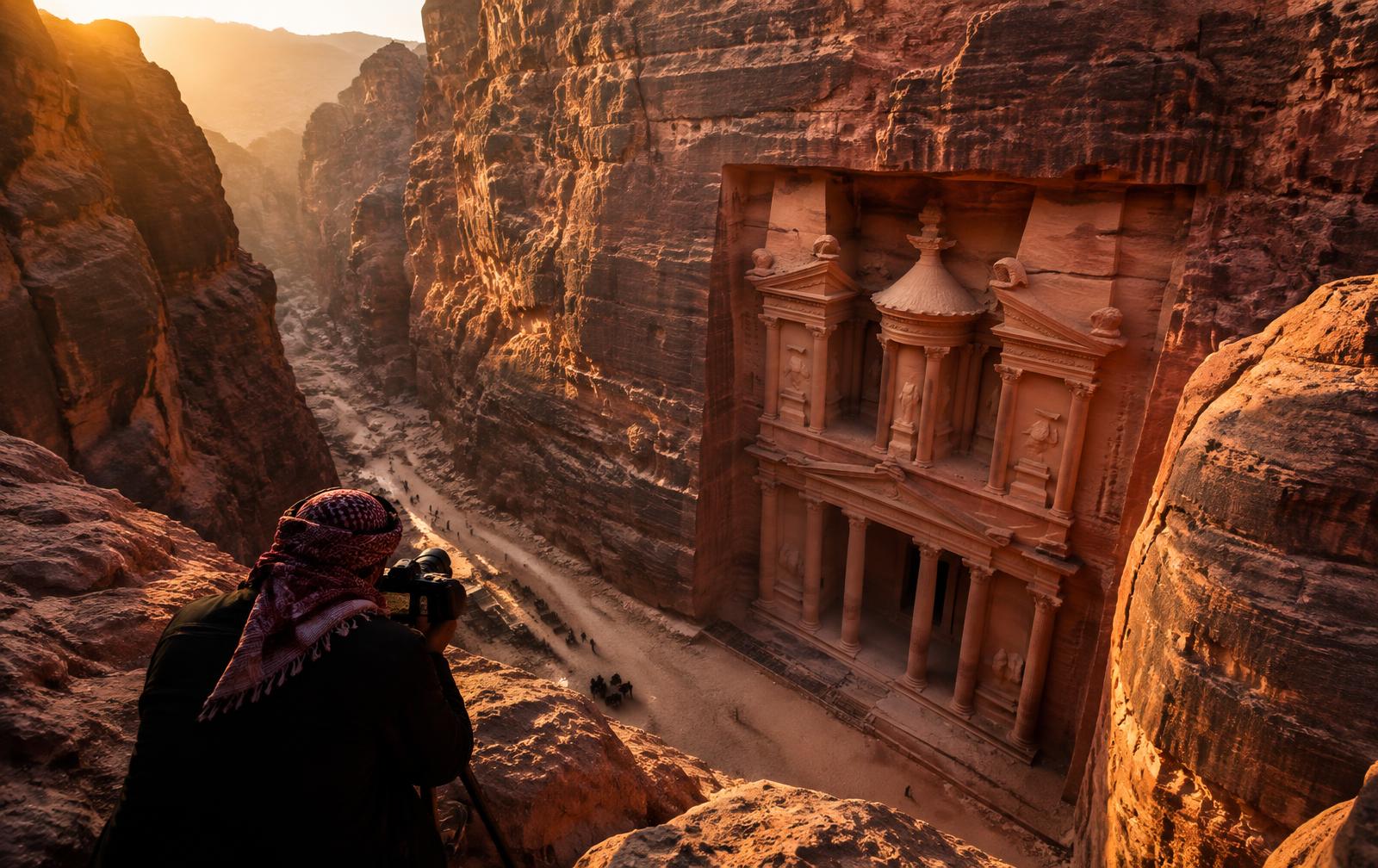
A documentary filmmaker photographing Petra at golden hour
An illustrative interpretation of creator-led destination storytelling in Petra.

09 · Distribution advantage

The personal brand as a complete media system

A large, trusted creator combines production, story, personality, distribution and community inside one brand ecosystem. The creator becomes the producer, presenter, channel and distribution network at the same time—shortening the distance between making a story and reaching its audience.

10 · Commercial maturity

From attention to credible partnership

In 2021, ITP Live announced an exclusive representation agreement with Hattab and cited work with Emirates, Sony, Samsung, Facebook and Fortnite. The progression illustrates a common creator-business path: audience → influence → commercial value.

11 · Business model

From creator to media enterprise

The brand can create economic value through platform monetization, relevant brand partnerships, destination marketing, media production and intellectual property. The accumulated films, formats, audience relationship and identity become business assets.

  • Platform monetization
  • Brand partnerships
  • Destination marketing
  • Media production
  • Intellectual property and repeatable formats

12 · Defensibility

What competitors cannot simply buy

A competitor can buy a camera, drone, editing software and plane ticket. The harder-to-copy advantages are accumulated brand equity, audience trust, narrative judgment, production experience, multi-platform distribution and reputation among viewers and partners.

Strategic synthesis

The Joe Hattab brand system

Underserved Intersection

Arabic language, global travel, documentary craft and digital distribution combined into one proposition.

Value Proposition Design

Discovery and emotional participation replace destination information as the central benefit.

Product Evolution

Budget travel develops into vlogging, documentary storytelling and a repeatable media brand.

Personal Brand Positioning

A consistent promise links the explorer, filmmaker and storyteller roles.

Community-Led Distribution

The audience is not only reached; it repeatedly travels through the creator's point of view.

Creator-Led Destination Marketing

Petra is reframed through narrative and visual perspective rather than conventional promotion.

Brand Equity

Trust, recognition, storytelling capability and distribution accumulate into defensible assets.

Media Brand Business Model

Attention converts into partnerships, production, destination campaigns and intellectual property.

Transferable learning

Nine lessons for modern brands

  1. 01

    Find an underserved intersection

    Do not ask only whether a category is crowded. Ask which language, audience, perspective or format remains underserved.

  2. 02

    Build a distinctive product

    Move beyond documenting activity toward a repeatable experience the audience can recognize before seeing the title.

  3. 03

    Create emotional value

    Facts earn attention briefly; human tension, discovery and empathy create memory.

  4. 04

    Make one promise consistently

    A personal brand becomes clear when each new story reinforces a familiar reason to return.

  5. 05

    Use identity as differentiation

    Arabic was not a barrier to scale. It was part of the market position.

  6. 06

    Own distribution relationships

    A direct, multi-platform audience reduces dependence on a single buyer or media gatekeeper.

  7. 07

    Turn attention into community

    Design participation and emotional proximity, not just impressions.

  8. 08

    Protect authenticity in partnerships

    Commercial work compounds brand value only when it remains relevant to the audience's expectations.

  9. 09

    Accumulate hard-to-copy assets

    Trust, editorial judgment and narrative capability take years; treat them as strategic capital.

Academic value

  • Personal branding — how a recognizable promise forms around a person without reducing the brand to personality alone.
  • Content marketing — how functional information becomes emotional and socially shareable value.
  • Positioning — differentiation through language, perspective, format and audience need.
  • Destination marketing — how creator-led storytelling can renew attention around an already famous place.
  • Digital business models — converting audience trust into partnerships, production capability and intellectual property.
  • Brand equity — why accumulated recognition, trust and distribution are more defensible than production equipment.

Questions for marketing students

  1. 01What market gap did Joe Hattab identify?
  2. 02How did his original value proposition evolve from 2016 onward?
  3. 03What makes his positioning different from that of a conventional travel vlogger?
  4. 04How does storytelling create emotional value beyond functional information?
  5. 05Why can Arabic-language content reach a global audience?
  6. 06Which elements of the Joe Hattab brand are most difficult for a competitor to copy?
  7. 07How does a large personal audience become a commercial asset?
  8. 08What role does authenticity play in creator marketing?
  9. 09How can tourism organizations work with creators without turning their content into conventional advertising?
  10. 10If you launched a creator brand today, which part of this model would you replicate—and which part would you change?

Joe Hattab did not build his brand simply by traveling to more countries. He turned travel into stories, stories into experiences, experiences into audience relationships, and those relationships into brand equity.

His product is not travel. His product is discovery—and his brand gives millions of viewers a reason to experience the world through a distinctly Arab storytelling lens.

Sources and notes

Audience figures are a 2026 snapshot reported by Joe Hattab's official website. Petra engagement figures are attributed to Jordanian news reporting. Illustrative travel images on this page were created for this study.

Back to all case studies